Welcome!

This blog grows out of my conviction that every aspect of our lives is sacred and is to be nurtured and celebrated as a good gift of God. Most of the posts will be the sorts of things you would expect from a historian and worldview teacher, but some are likely to be a bit surprising. Since God created all things good, including all aspects of human life, everything is interesting and important from the perspective of a biblical worldview. Everything under the Sun and under Heaven is thus fair game here. I hope you find it interesting and enjoyable.

Saturday, October 6, 2012

Common Sense Economics


It’s been a while since I’ve posted anything specifically for the blog—the start of the new semester and a heavy teaching load has taken its toll, I’m afraid—so I thought it would be a good time to post on a few books I’ve read lately on economics that cut through a lot of the clutter and rhetoric we hear regularly today and that will give you a good grounding in basic economic theory and what works in the real world.

The first book is Common Sense Economics: What Everyone Should Know About Wealth and Prosperity, by James D. Gwartney, Richard L. Stroup, Dwight R. Lee, and Tawni H. Ferrarini. The book lays out in clear and simple terms key elements of basic economics. (If you think that sounds boring, you need an attitude check: how can you even begin to vote intelligently in an election in which the economy is a major issue if you are clueless about how it works?)

Part one covers Twelve Key Elements of Economics:

  1. Incentives matter.
  2. There is no such thing as a free lunch.
  3. Decisions are made at the margin.
  4. Trade promotes economic progress.
  5. Transaction costs are an obstacle to trade.
  6. Prices bring the choices of buyers and sellers into balance.
  7. Profits direct businesses toward activities that increase wealth.
  8. People earn income by helping others.
  9. Production of goods and services people value, not just jobs, provides the source of high living standards.
  10. Economic progress comes primarily through trade, investment, better ways of doing things, and sound economic institutions.
  11. The “invisible hand” of market prices directs buyers and sellers toward activities that promote the general welfare.
  12. Too often the long-term consequences, or secondary effects, of an action are ignored.

Part two covers Seven Major Sources of Economic Progress:

  1. Legal system: The foundation for economic progress is a legal system that protects privately owned property and enforces contracts in an evenhanded manner.
  2. Competitive markets: Competition promotes the efficient use of resources and provides continuous stimulus for innovative improvements.
  3. Limits on government regulation: Regulatory policies that reduce trade also retard economic growth.
  4. An efficient capital market: To realize its potential, a nation must have a mechanism that channels capital into wealth-creating projects.
  5. Monetary stability: A stable monetary policy is essential for the control of inflation, efficient allocation of investment, and achievement of economic stability.
  6. Low tax rates: People will produce more when they are permitted to keep more of what they earn.
  7. Free trade: A nation progresses by selling goods and services that it can produce at a relatively low cost and buying those that would be costly to produce domestically.

Part three covers Ten Elements of Clear Thinking About Economic Progress and the Role of Government:

  1. Government promotes economic progress by protecting the rights of individuals and supplying a few goods that are difficult to provide through markets.
  2. Allocation through political voting is fundamentally different from market allocation, and economic analysis indicates that the latter is more consistent with economic progress.
  3. The costs of government are not only taxes.
  4. Unless restrained by constitutional rules, special-interest groups will use the democratic political process to fleece taxpayers and consumers.
  5. Unless restrained by constitutional rules, legislators will run budget deficits and spend exclusively.
  6. Government slows economic progress when it becomes heavily involved in providing favors to some at the expense of others.
  7. The net gain to those receiving government transfers is less, and often substantially less, than the amount they receive.
  8. Central planning replaces markets with politics, which wastes resources and retards economic progress.
  9. Competition is just as important in government as in markets.
  10. Constitutional rules that bring the political process and sound economics into harmony will promote economic growth.

Lastly, part four covers Twelve Key Elements of Practical Personal Finance:

  1. Discover your competitive advantage.
  2. Be entrepreneurial. In a market economy, people get ahead by helping others and discovering better ways of doing things.
  3. Use budgeting to help you save regularly and spend your money more effectively.
  4. Don’t finance anything for longer than its useful life.
  5. Two ways to get more out of your money: Avoid credit-card debt and consider purchasing used items.
  6. Begin paying into a “real-world” savings account every month.
  7. Put the power of compound interest to work for you.
  8. Diversify—don’t put all of your eggs in one basket.
  9. Indexed equity funds can help you beat the experts without taking excessive risk.
  10. Invest in stocks for long-run objectives, but as the need for money approaches, increase the proportion of bonds.
  11. Beware of investment schemes promising high returns with little or no risk.
  12. Teach your children how to earn money and spend it wisely.

This is a long list of principles, many of which you may already know. For most of us, however, there are important principles to be learned that have huge implications for our personal lives as well as for how we view government policies. (This is an equal opportunity problem—both parties in the U.S. regularly violate key principles outlined in this book.)

I was particularly struck by the discussion of the importance of information and the connection between information and prices. This goes a long way toward explaining why centrally planned economies have never worked.

All in all, this is a short book, easy to understand, that will bring you up to speed quickly on key ideas in economics. Highly recommended.

Next up: books on moral and theological arguments related to economics. Stay tuned.

Monday, October 1, 2012

Aristotle and Augustine

My next article on Christianity and Politics is out at the Colson Center. It is about Aristotle, his influence on medieval thinking on politics, and the influence of Augustine and Aristotle on the development of the U.S. Constitution.

Saturday, September 22, 2012

Podcast on Elections, Non-Profits, and Separation of Church and State

I'm featured on Breakpoint This Week talking about church and state issues and particularly the Johnson amendment, which is what made it illegal for nonprofits to advocate for candidates in elections: http://www.breakpoint.org/features-columns/discourse/entry/15/20361

Thursday, September 20, 2012

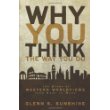
Why You Think the Way You Do hits its sixth printing

My book Why You Think the Way You Do: The Story of Western Worldviews from Rome to Home has just had its sixth printing, bringing the total number of print copies to 9,144. It's also available in e-book form. The next printing will bring the total to over 10,000.


Tuesday, September 18, 2012

My new E-Book is out

Portals: Entering Your Neighbor's World, my new e-book on comparative worldview, is now available. You can get it at Smashwords for all e-book formats at Smashwords,  https://www.smashwords.com/books/view/236946, and at Amazon specifically for Kindle, http://www.amazon.com/dp/B009CJEH40. The print edition should be out in a couple of weeks.

I wrote this book at the request of Chuck Colson. He wanted me to expand out his worldview grid, writing a page or two on each box of the grid. We had planned to publish it through a few Christian publishers, but they dragged their feet until it became clear that it didn't fit their requirements. It seems that it was too short to be considered an academic book. So I'm self-publishing it under my own imprint, Every Square Inch Publishing.

Wednesday, September 12, 2012

Augustine's The City of God and the Western political tradition

I've got a new article at the Colson Center on Christianity and the development of Western political ideas. This one focuses on the impact of Augustine's The City of God and the problem of corruption in politics.

Monday, September 3, 2012

Racism and Republicans


A friend of mine posted this article by Steve Schneider on Facebook. On one level it is hard to take it seriously: Eastwood’s admittedly bizarre performance at the RNC made no mention implicitly or explicitly about race that I could see. Schneider’s post falls into the familiar theme of accusing anyone who criticizes the President of racism and contributes to the ever increasing list of words and phrases that are now claimed to be code words for race (including cool, Chicago, golf, food stamps, experienced, kitchen cabinet, Obamacare, professor, and now empty chair, among others).

Why in the world would someone look at what Eastwood did and think it was racist? To me, that accusation looks like a cynical attempt to manipulate opinion in the Black community.

Then the answer hit me. As H. M. Tomlinson observed, we see things not as they are but as we are.

While some of the accusations of racism may in fact be cynical, some people genuinely see the world in racial terms, whether because of their education or their experience, and so they naturally assume that everyone else likewise has race as a primary element of their thoughts, words, and actions.

But race is not at the center of everyone’s worldview. I rarely think in terms of racial categories; in fact, I rarely think of race at all. To people who think in racial categories, that statement would probably smack of “white privilege” and would be de facto evidence of a racist attitude. Or the argument could be framed in terms of subconscious racism. Or more simply, it could be argued that I’m lying.

My response? It ain’t necessarily so (to quote Sportin’ Life in “Porgy and Bess”). I would simply ask if you have any evidence of racism beside your assumption that it must be there. If not, then maybe you should consider whether your assumptions about how other people think are correct. Just because race is central to your mental framework doesn’t mean it is to mine. Or to Eastwood’s.

This whole situation is a fine example of postmodernism at work. The postmodernist argues that truth either doesn’t exist or can’t be known, and therefore all viewpoints are equally valid. So from Schneider’s perspective, Eastwood was a racist. From Eastwood’s perspective, he wasn’t. This means that both sides can yell at each other and feel perfectly justified and righteous in their anger, and the rest of us are free to accept whichever side confirms our political position. It’s a win-win—everyone can have the moral high ground while holding the other side in contempt.

It is also a great example of the problem with postmodernism. Both perspectives cannot be true. If you claim Eastwood’s a racist, prove it by what he said or did, not by the intellectual construct you superimpose on his performance. If you can’t, take him at his word that he’s criticizing the president’s policies because he thinks they didn’t work, not because of racism.

The Golden Rule says we are to do onto others what we would have them do onto us. That means that unless you want people to attribute the worst motives to you, don’t do it to them. And if you want people to take your words and arguments at face value, do the same for them.

That’s a lesson people on all sides of the political spectrum need to learn.